As a visitor to Cape Town, you've probably been warned about the high crime-rate in South Africa; and more particularly the crime rate in Cape Town.
Sadly, South Africa is the most unequal country in the world, according to the World Bank[1] with extreme levels of unemployment, resulting in poverty and crime.
Statistically, there can be no doubt that South Africa suffers a very high level of crime:
"Five of the 10 cities with the highest crime rates worldwide are found in South Africa", according to 2022 data from the Mexican Citizen Council for Public Security and Criminal Justice [2].
Considering murder alone, Cape Town is top of the list with 3231 homicides, Durban second with 3138, Johannesburg third with 2547[3]. When you consider the number of murders as a percentage of the population, Cape Town drops to 18th and Nelson Mandela Bay goes up to take 5th place.
One morning, I picked up two terrified young American visitors from a hotel on the Foreshore area of Cape Town. They had been mugged at knifepoint the previous evening and their assailants got away with an iPhone worth about R30000.
About mid-afternoon, they had asked at reception if it was safe for them to walk up to the nightlife area of Long Street, in the City centre and were advised it was safe to do so. They didn't encounter any problems and enjoyed a very pleasant evening ... until it was time to make their way back to their hotel.
Unsure of the way back they used Google Maps, which directed them away from the city centre and through an area inhabited by homeless people who sleep on the streets or in makeshift shelters. Crossing a bridge - only 300m from their hotel - they were confronted at knifepoint, lost the iPhone, but managed to flee unharmed.
I've never met any other visitors to Cape Town, who have been victims of crime; and the real question is not so much how high the crime-rate is, but where the crime happens. Google Maps might know how to get there, but Google Maps does not know what is on the way there.
Every city has its dangerous areas and without local knowledge, anyone could be a victim.
In the Cape Town Central Business District (CBD), you'll notice law enforcement officers every few blocks, who are generally very helpful and will give you advice or escort you if necessary. They'll be more helpful than the South African Police Services and will warn you about phone-snatchers and advise you not to have your wallet or mobile phone sticking out of your back pocket.
Stay sober, ignore the drug peddlers and prostitutes and you can spend a very pleasant, fun evening in Long Street; up into the early hours of the morning. But get lost or stumble drunk down a dark side-street and you could be in trouble.
The central CBD area of Cape Town is therefore relatively safe, if you take the right precautions ... as you should anywhere in the world. Local knowledge is the key!
Be aware of scammers and don't assume everyone who approaches you has any authority.
- The 'car guards' you see directing vehicles into parking bays have no authority and do not control the parking bays, they appear to. The hi-visibility vests they wear are not issued and the traffic cones you see them using, are probably stolen.
- And don't be fooled into believing you have to pay a 'toll' or a 'parking fee' - ask for identification from anyone assuming authority to charge you for anything.
- When buying tickets for the cable car, make sure you're using the correct website (tablemountain.net) and not a fake; or book your tickets through a tour guide.
- And make sure your guide is legal, because there are numerous illegal tour guides. All tour guides must (by law) be registered with provincial government (which must be renewed every two years) and must carry their registration cards. Ask to see it - the expiry date will indicate if they're currently registered and the reverse side will tell you what they are qualified to do.
If in doubt, call us for some free advice +27 (0) 845907100
Safety on the mountains
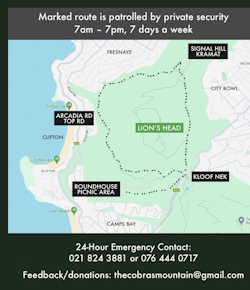
Criminals need an escape route, so generally, the higher up you are the safer you are. An exception to this are the mountains of the Silvermine Nature Reserve, above Kalk Bay.
Around Lions Head and Signal Hill, look out for the Cobra rangers who patrol the area and can be contacted on 021 8243881 or 0764440717. If you need help anywhere else on the mountains, contact the Metro Rescue Services on 021 937 0300 or 112 (mobile).
 In general, the more dangerous areas are on the periphery of the CBD, in the townships and around the lower slopes of the mountain. If you want to venture into these areas, get some local advice, book a tour or get a guide to escort you.