Most people would probably consider the difficulty of a hike to refer to how strenuous it is, but 'difficulty' can mean more than 'how strenuous is the hike?' ... or 'how fit must I be?'
EFFORT
We use Naismith's Rule [1] to benchmark an average maximum of 25km/day of hiking on a flat path at 3km/hr for 8 hours and we benchmark that at 10. So, if you are capable of 25km over 8hrs, then you are capable of a hike that is graded a 10, or less.
But no hike is a flat path from one end to the other, so we adjust that to combine the height gain (HG) with the distance, where every 100m of height gain adds 10min, which is equivalent to 0.5km on a level path.
So, we use the formula: Effort = ( Distance [km] + HG/200 [m] ) / 2.5 ... to evaluate the energy/effort you will need to complete the hike, on a scale of 1 to 10.
So, the question to ask yourself is how much of 25km over 8hrs, are you capable of. If you're capable of the entire 25km, that would be a 10.
Platteklip Gorge is 2.5km and 700m of height gain, which means 2.5 + 3.5 = 6 / 2.5 = 2.4 - which is just less than a quarter of what you should be able to do in 8hrs.
India-Venster is about 3.5km and 700m of height gain, which means 3.5 + 3.5 =7 /2.5 = 2.8
Constantia Nek (Jeep Track) to the Summit and then the cableway, is about 14km and 700m of height gain, which calculates to: 14 + 3.5 = 17.5 / 2.5 = 7
TERRAIN
Walking on a flat path is easier than having to use your hands to scramble up and over steep sections, or rock faces.
Can you walk easily and without any restriction? ... do you have enough upper-body strength to pull yourself up over a rock-face, without losing your balance?
If you have a physical disability or are suffering an injury, your ability to walk or to climb up and over rock-faces might be restricted.
So, 'difficulty' could also mean your ability to move over the terrain you're hiking over.
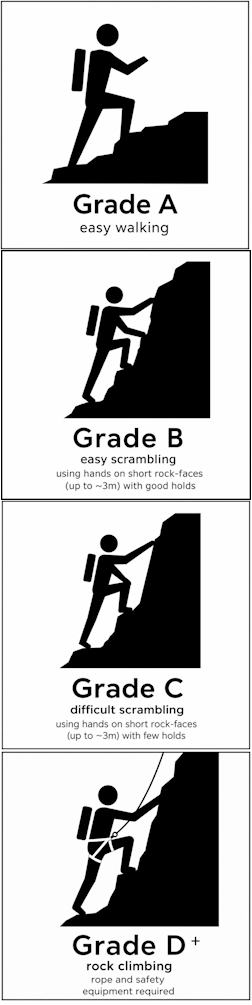
Here we grade the route an A, B, C or D, as illustrated in the graphics.
We refer to A-grade routes as 'walking', B and C-grade routes as 'scrambling' routes and D is rock-climbing which requires the use of safety equipment.
FEAR OF HEIGHTS
Another factor that could affect your capacity is a fear of heights, but this is a psychological factor. It is perfectly normal to be cautious or even scared when exposed to heights, but some people suffer a phobia, referred to as acrophobia.
When a person with acrophobia looks down from a high place, their brain misinterprets the height as an immediate, life-threatening danger. This misinterpretation activates the body's natural fight-or-flight response.
Instead of fighting or fleeing, however, people with severe acrophobia often experience a third variation of this survival loop: the "freeze" response, which causes a physical paralysis or inability to move. This only affects about 3% of people.
We can't predict how you might respond to the exposure you might experience, but we can warn that on B and C-grade scrambling routes, you will be exposed to heights up to about 20m.
Furthermore, reassurance, encouragement and safety equipment (like a rope) are usually enough for most hikers to get over the psychological barrier.
 Assess your capactity against these three factors and you have a good idea of how easy or difficult it will be to hike Table Mountain. Ready for the adventure?